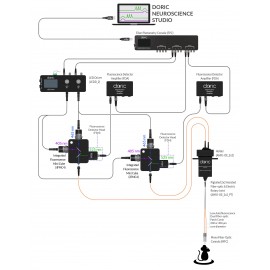
Though a potent experimental technique for analyzing neural circuitries, there exist numerous benefits to the incorporation of optogenetic technology. Among these is the fact that neural circuits interrogation is made feasible with the use of optogenetic technology. This is so as optogenetics helps in the analysis of mental disorders as well as the perceptions that might arise as a result of such diseases. Optogenetics works to make this possible by modulating the activity of different types of neurons. Another benefit of optogenetics is the fact that this technology is incorporated into the process of cracking neural codes. This is where the two processes of activation and inhibitions by optogenetics are exercised. Generally, pulses of light representing neural codes are produced in a firing pattern. These codes are then studied on polysynaptic neurons.
As a result of such an understanding, a measure of the activity within neural circuitries is made possible. One can also understand how these activities draw behind the behavior. Another benefit of optogenetic technology is the fact that targeting of specific cells in the neurons is made a possibility. This is so as optogenetics works by expressing proteins that are light sensitive onto the interested cells in the brain. As a result, one can, therefore, control gene delivery. The bidirectional control of neural activities all simultaneously is also another benefit that comes with optogenetic technology. By simultaneously controlling the bidirectional activities of neurons, it is possible to manipulate the activities of such neurons. The extent of this application makes it feasible to be performed under larger networks such as the cortex. See this page: https://www.britannica.com/technology/submarine-photometer.
The bidirectional control of circuits of the neurons can also be used in the reversible generation of patterns for diseases. From such an application, it is possible to generate new models of neurological disorders that can then be studied to find new treatments. Due to the fact that neural cells can be controlled selectively, it is therefore also possible to make efficient mental treatments with the very least side effects. Optogenetic technology with https://amuzainc.com/teleopto-wireless-optogenetics/also plays a huge role in neuroscience. This is so as its application onto the complex network of subcortical connections and cortical connections relate greatly to neuroscience.
Specifically, how these complex connections govern the sensory and motor functions of the brain makes optogenetic technology by Amuza Incfeasible to neuroscience. Optogenetic technology is also beneficial in understanding the progression of circuit dynamics of the neurons. This, therefore, makes it possible to improve post-stroke recovery strategies. This is of critical essence as any injury to the brain that may be brought about by a stroke might not only affect the damaged area but also any other r region that might be linked to it. Optogenetic technology can also be incorporated into optical stimulation. From such technology, it becomes possible to generate pattern sequences of the desired illumination.
 Photometrysite